
Mechanistic Interpretability
Reverse-engineering the black box
Mechanistic interpretability is the discipline of reverse-engineering artificial neural networks to improve understanding of the mechanisms that generate their observed behaviours. Instead of just evaluating behavior based on inputs and outputs, practitioners dissect the model's individual neurons and abstract latent spaces to map out their processes and derive the exact mathematical basis driving their behavior. The ultimate goal is to enhance AI safety and reliability while improving design engineering knowledge.Locating What Matters
Attribution — activation patching, path patching, and the logit lens trace which components causally drive a given output.
Decomposing Representations
Sparse autoencoders and dictionary learning pull superposed activations apart into sparse, human-interpretable features.
Finding Circuits
Automated circuit discovery and attribution graphs chain those features into a readable, layer-by-layer computational graph.
Validation
Synthetic ground-truth tasks (like the HMM sandbox below) and causal scrubbing test whether a proposed circuit actually explains the behavior.
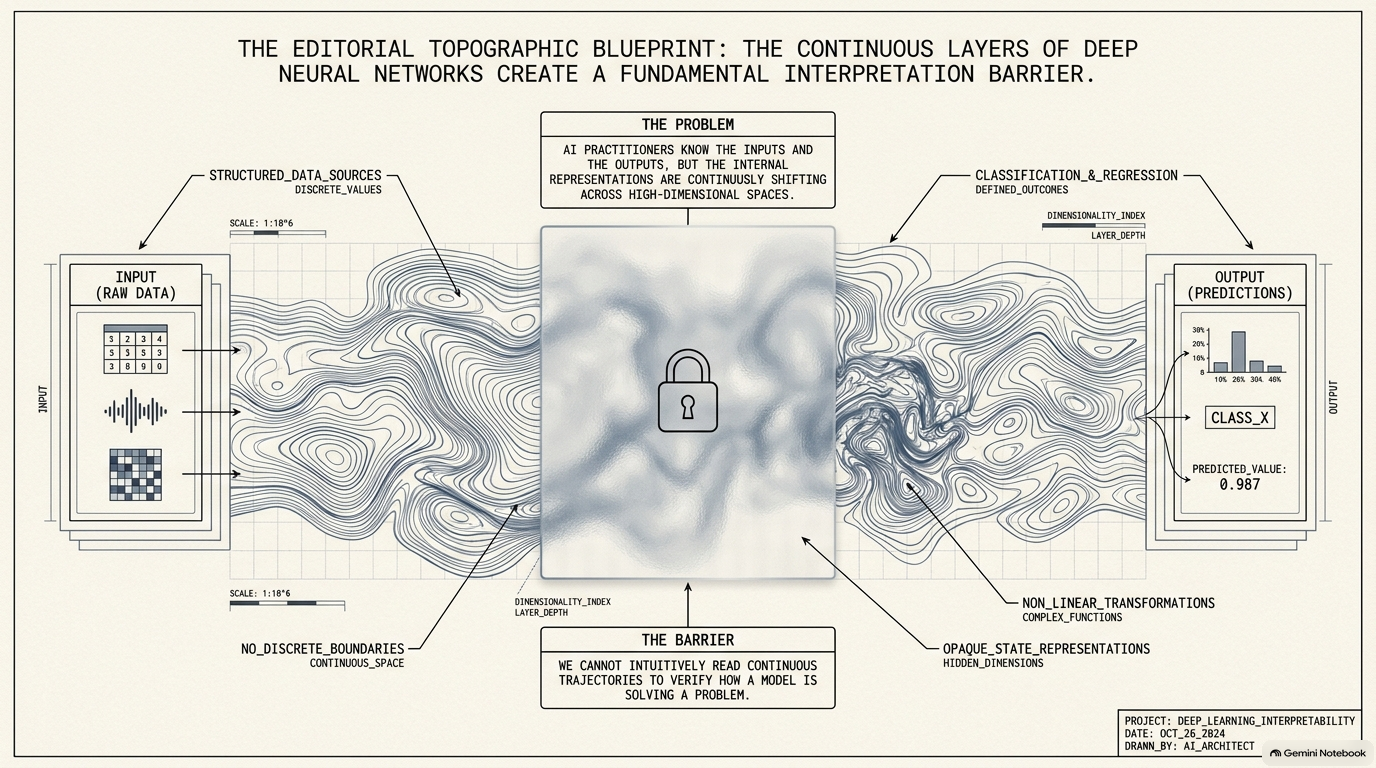
Why continuous, high-dimensional layers resist intuitive inspection in the first place.
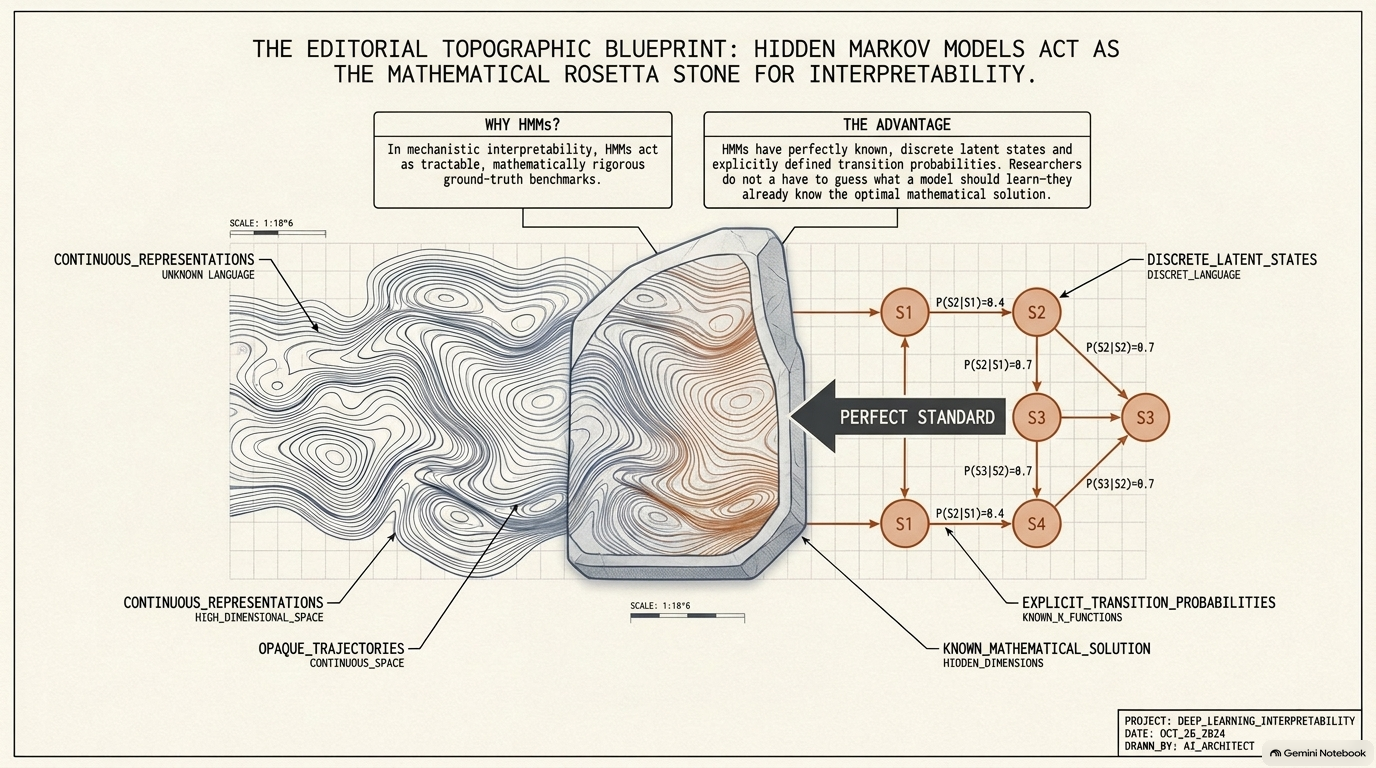
Why HMMs make a useful ground-truth benchmark: known discrete states, known transition probabilities.
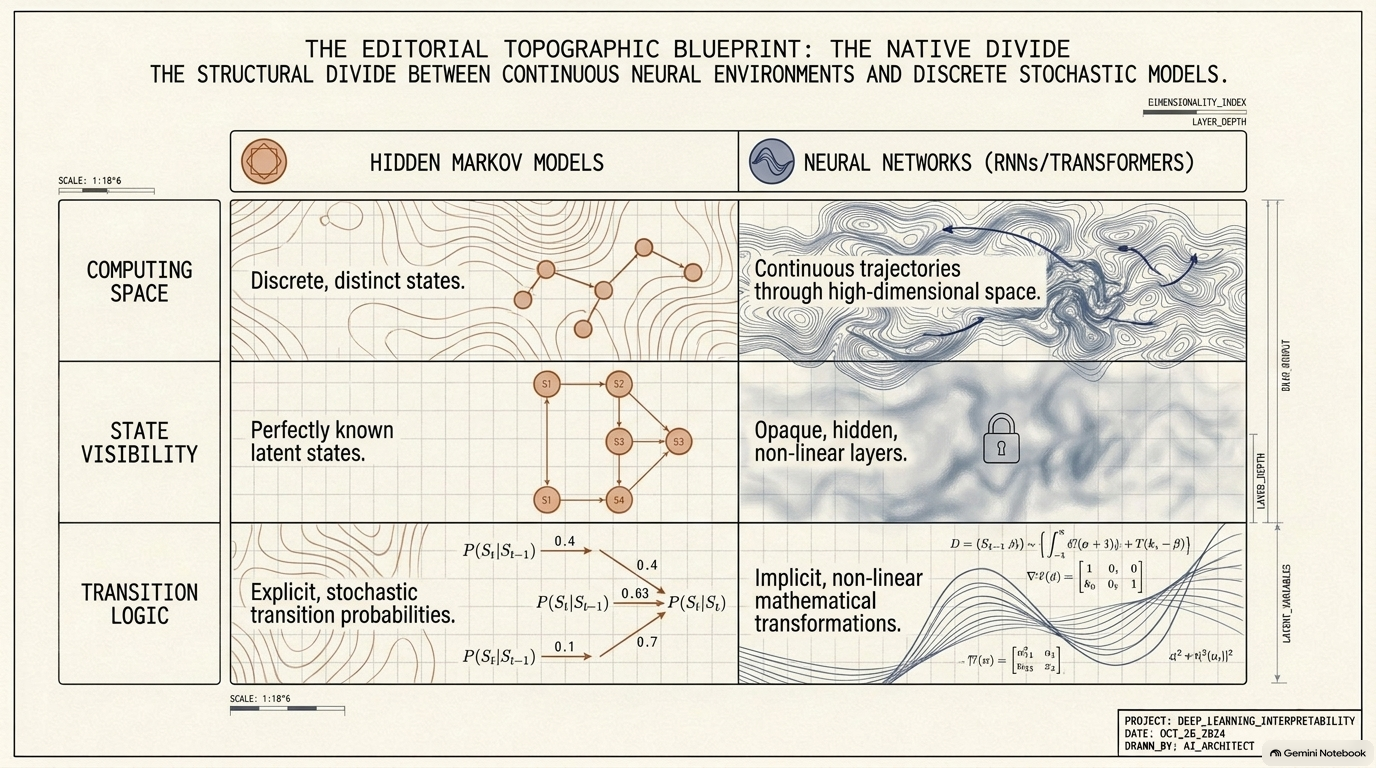
Comparing the two systems head-to-head across computing space, state visibility, and transition logic.
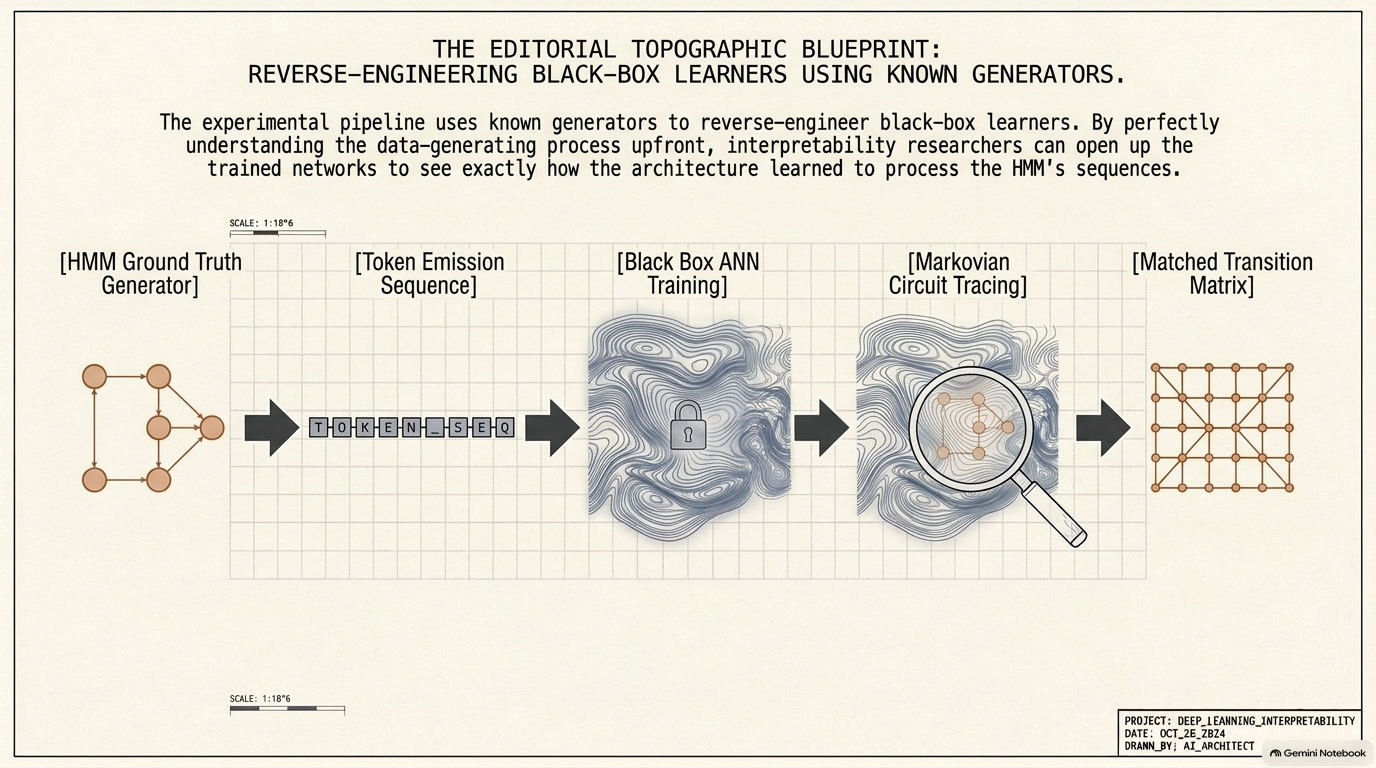
The experimental pipeline: a known generator trains the model that researchers then try to reverse-engineer.
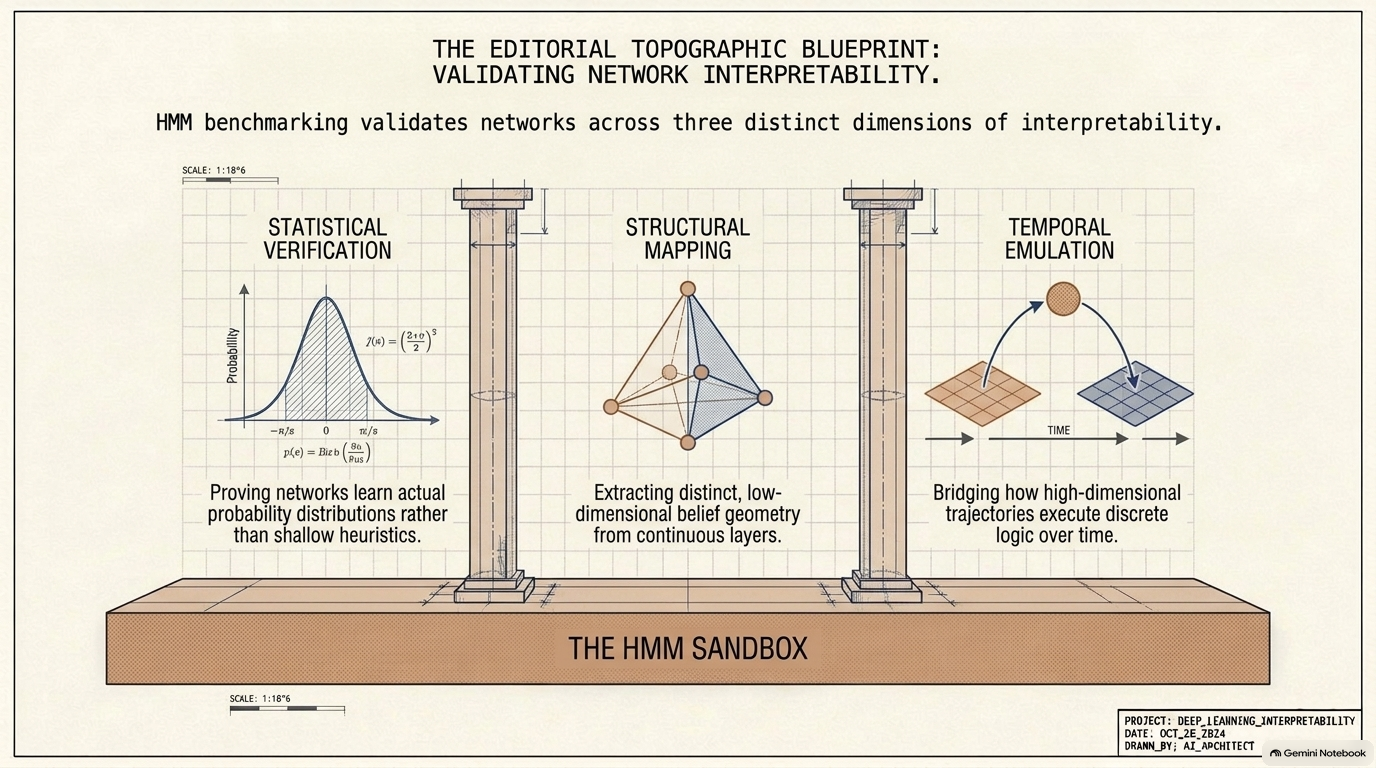
Three angles of proof the sandbox is built to deliver, from statistics to timing.
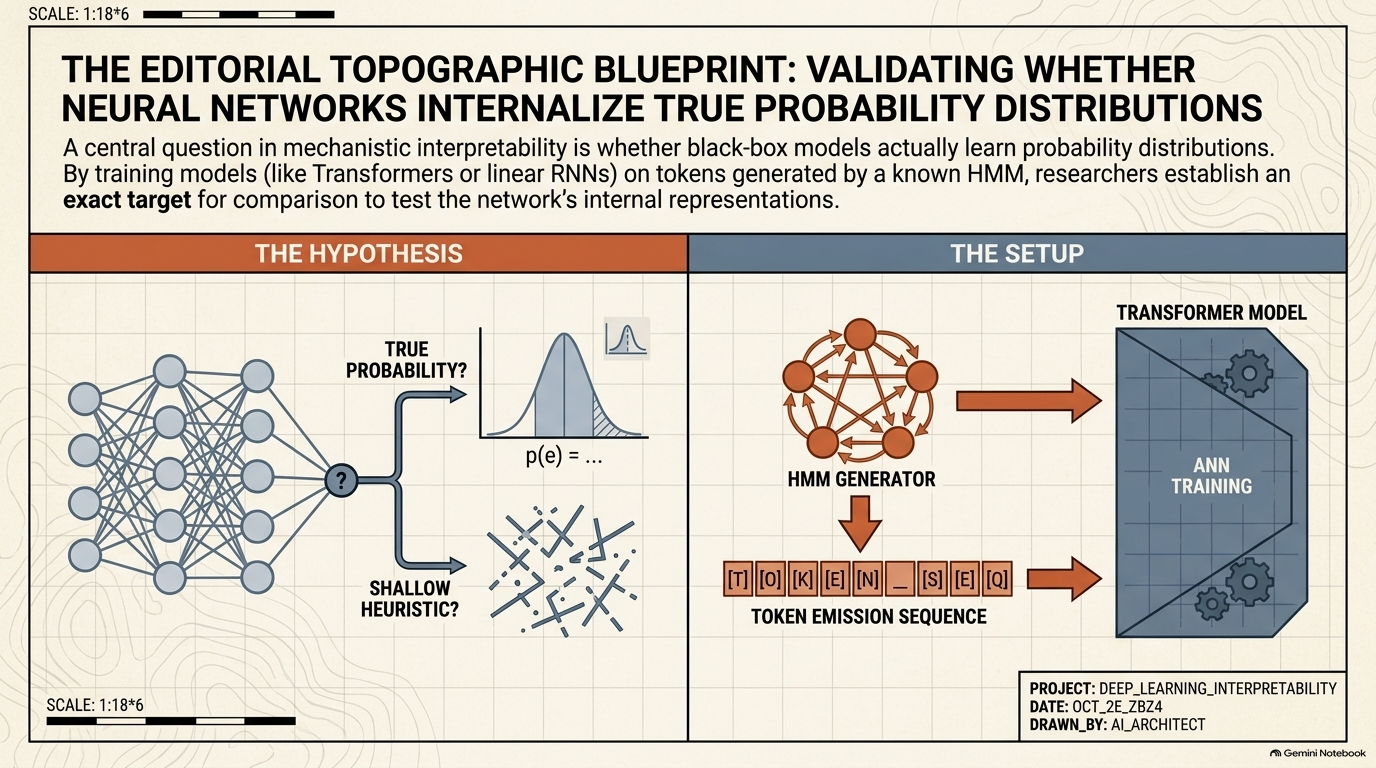
The core question up front: do trained networks recover real probabilities, or just shallow shortcuts?
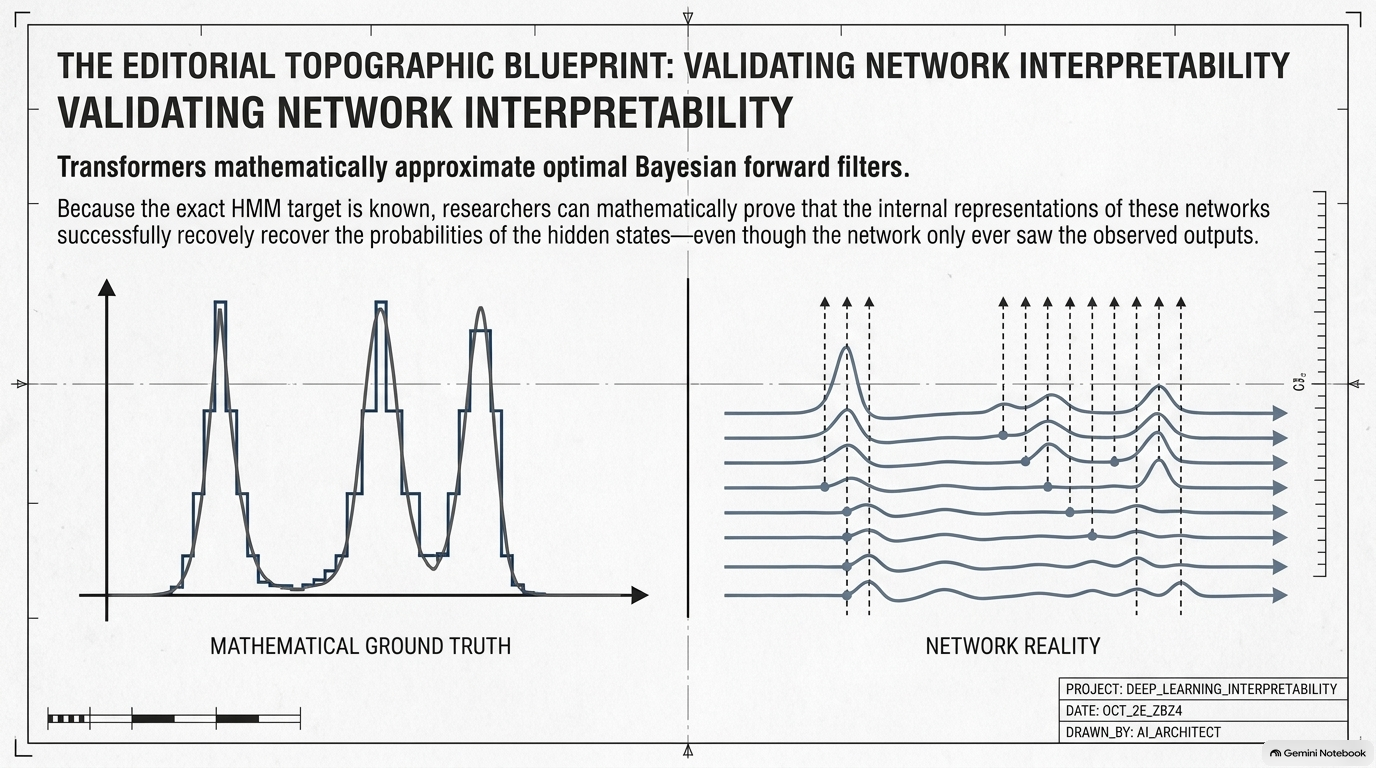
Comparing the exact mathematical answer against what the trained network actually produced.
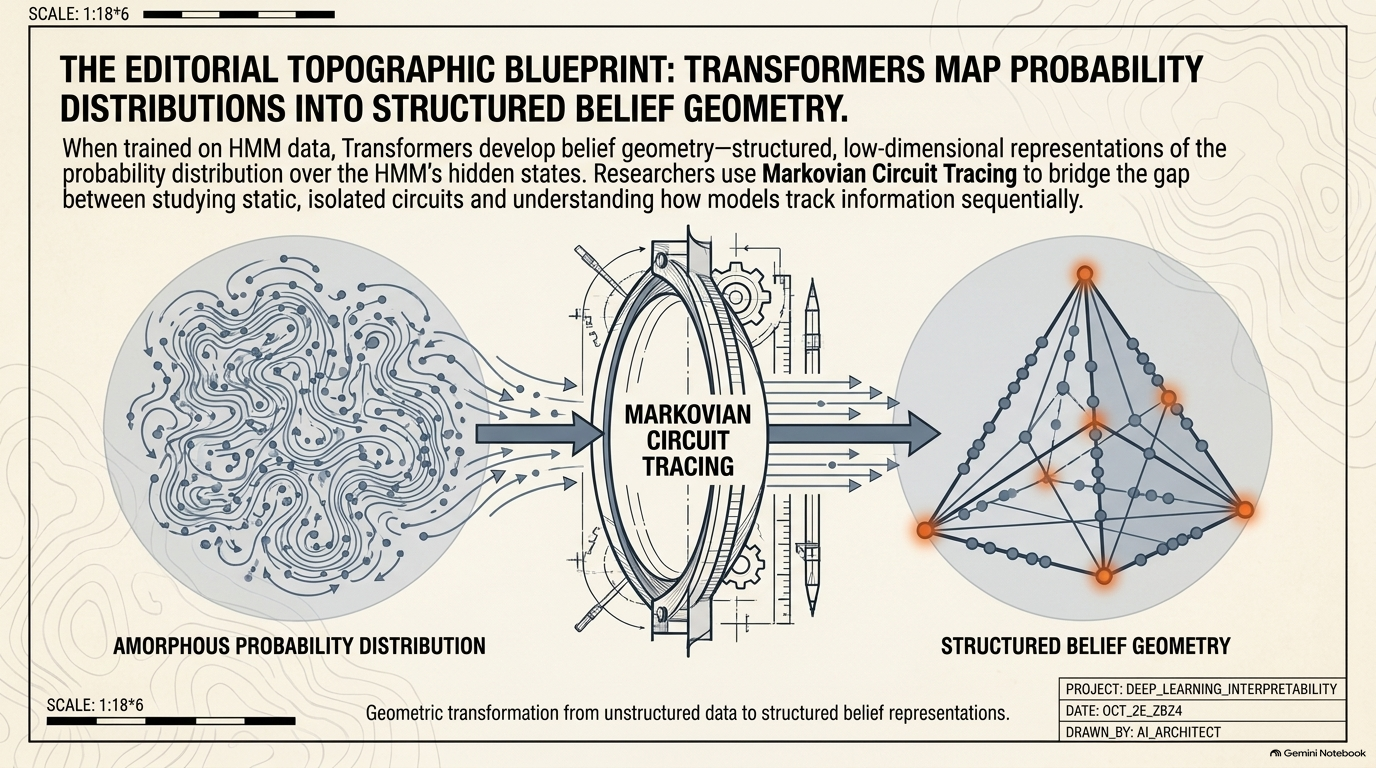
How an unstructured internal representation resolves into an organized geometric shape.
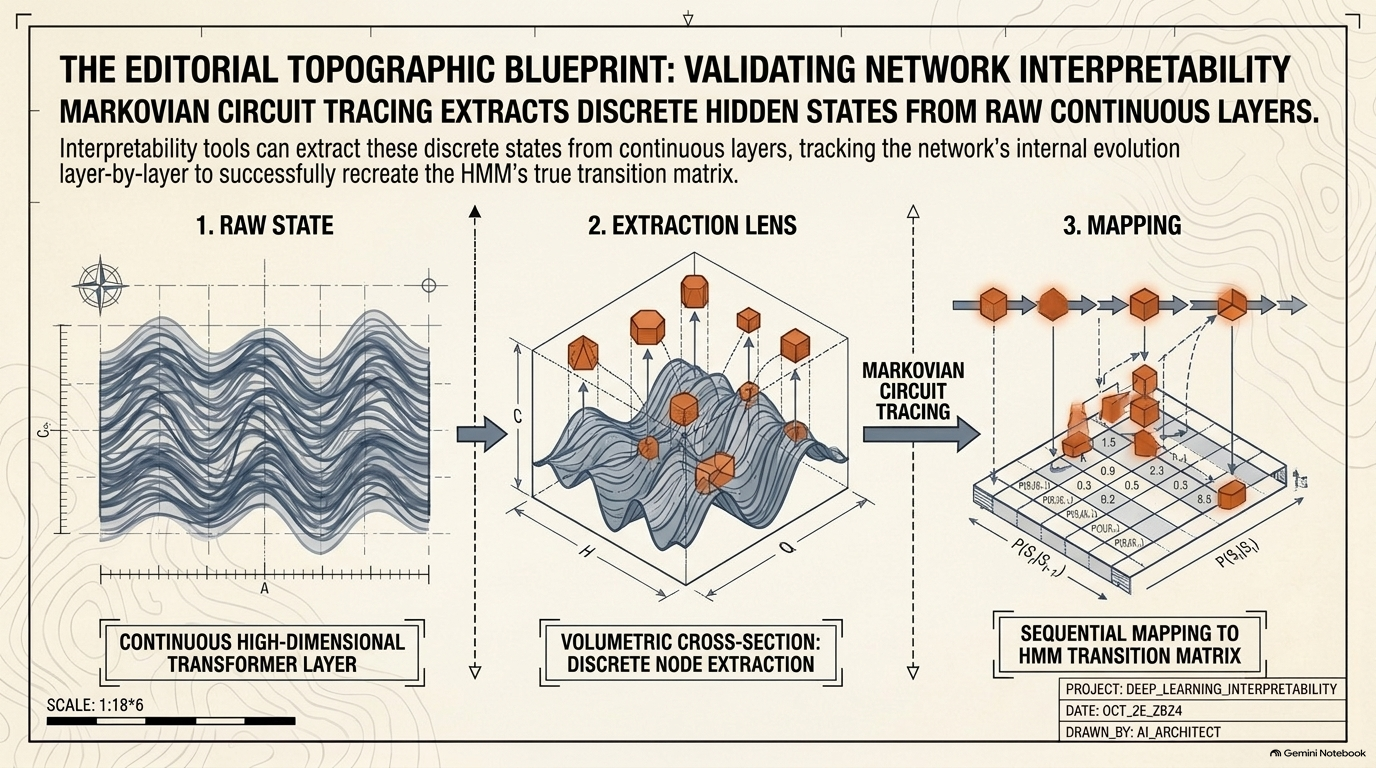
The extraction method, step by step, from raw activations to a recovered transition matrix.
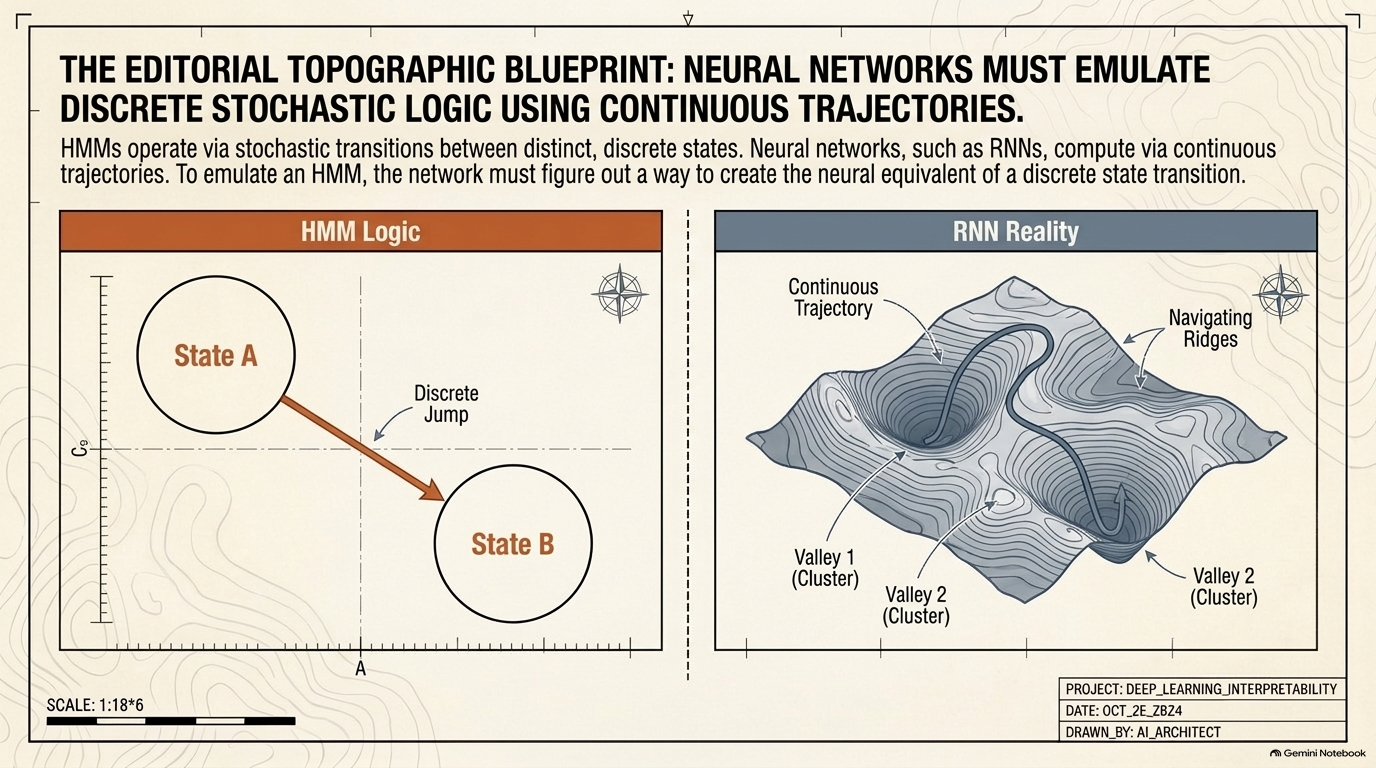
The mismatch a network has to overcome: discrete jumps on one side, smooth trajectories on the other.
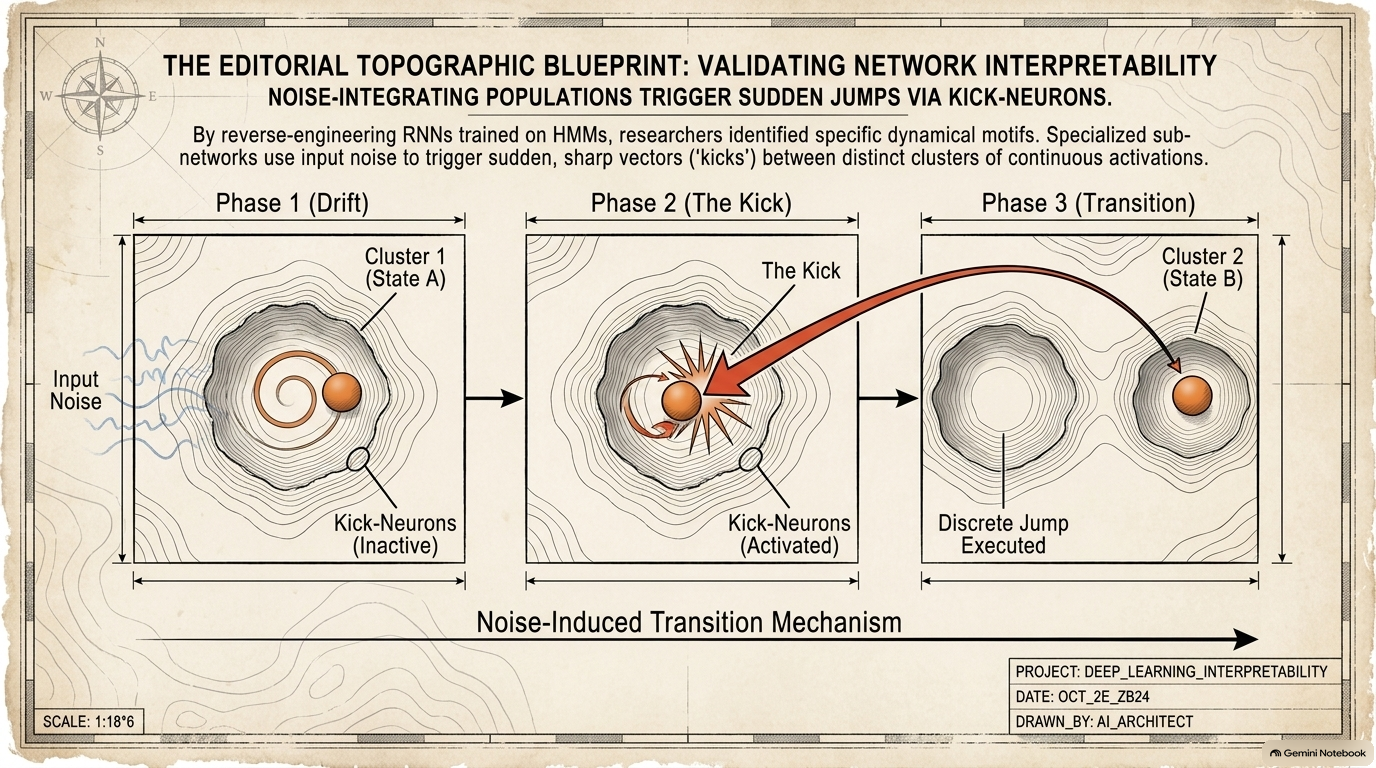
The dynamical motif researchers found for how a continuous system executes a discrete jump.
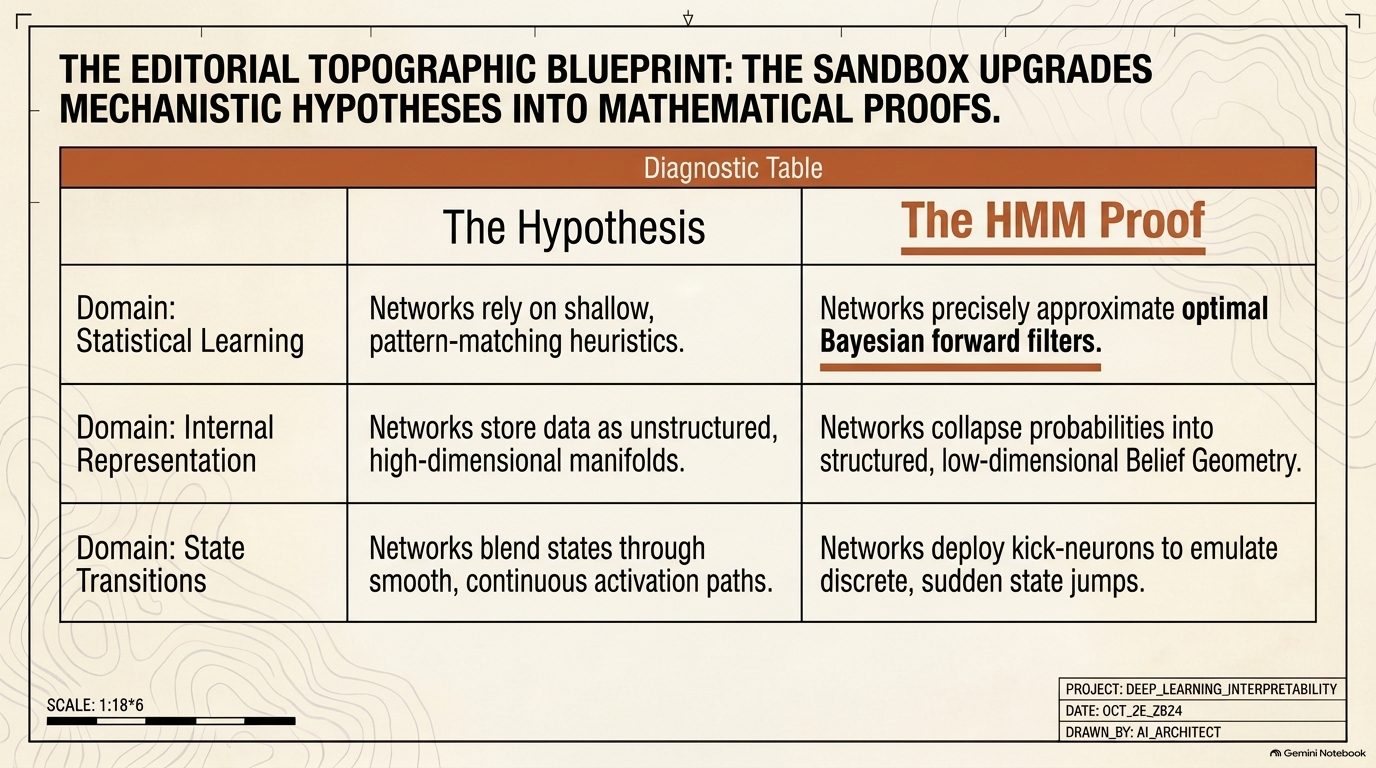
Each mechanistic hypothesis paired with the mathematical result the HMM sandbox confirmed.
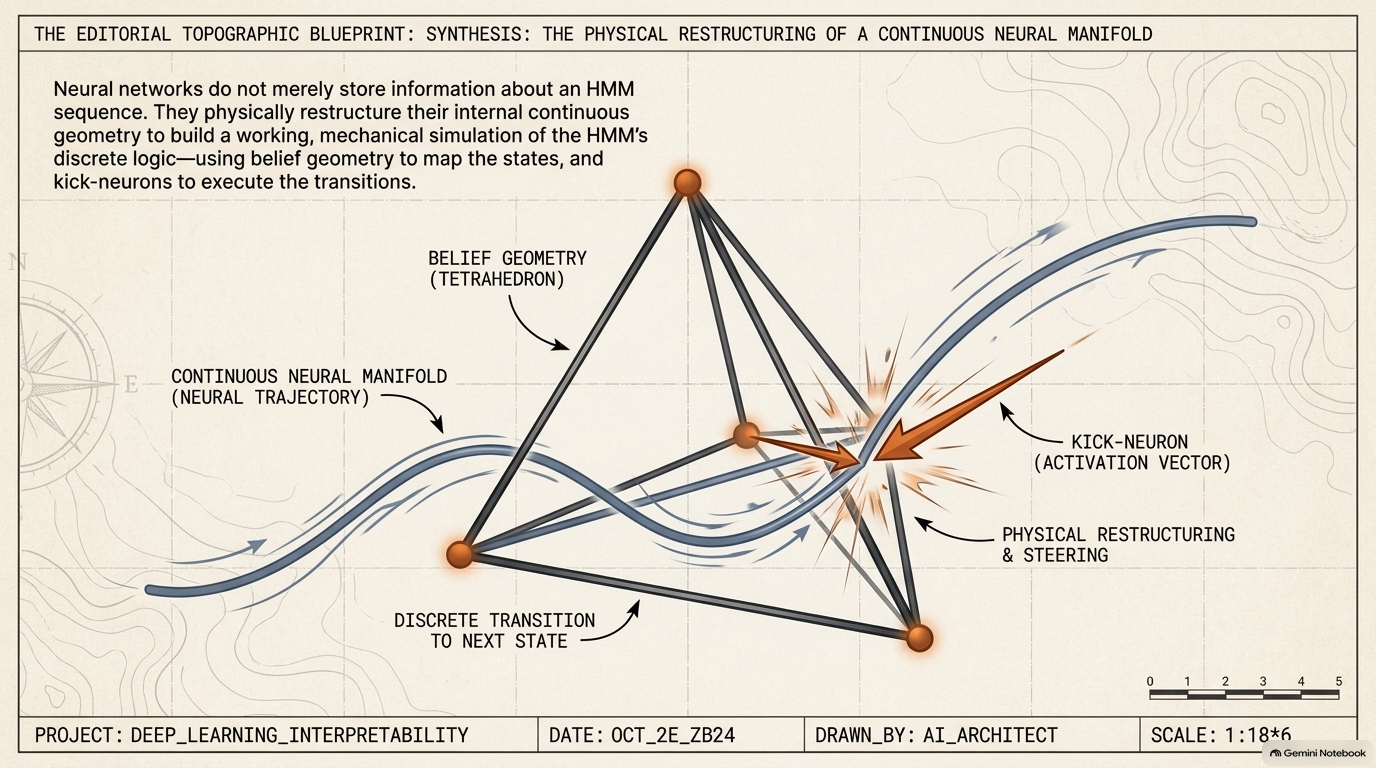
Bringing belief geometry and kick-neurons together into one picture of the network's internal simulation.
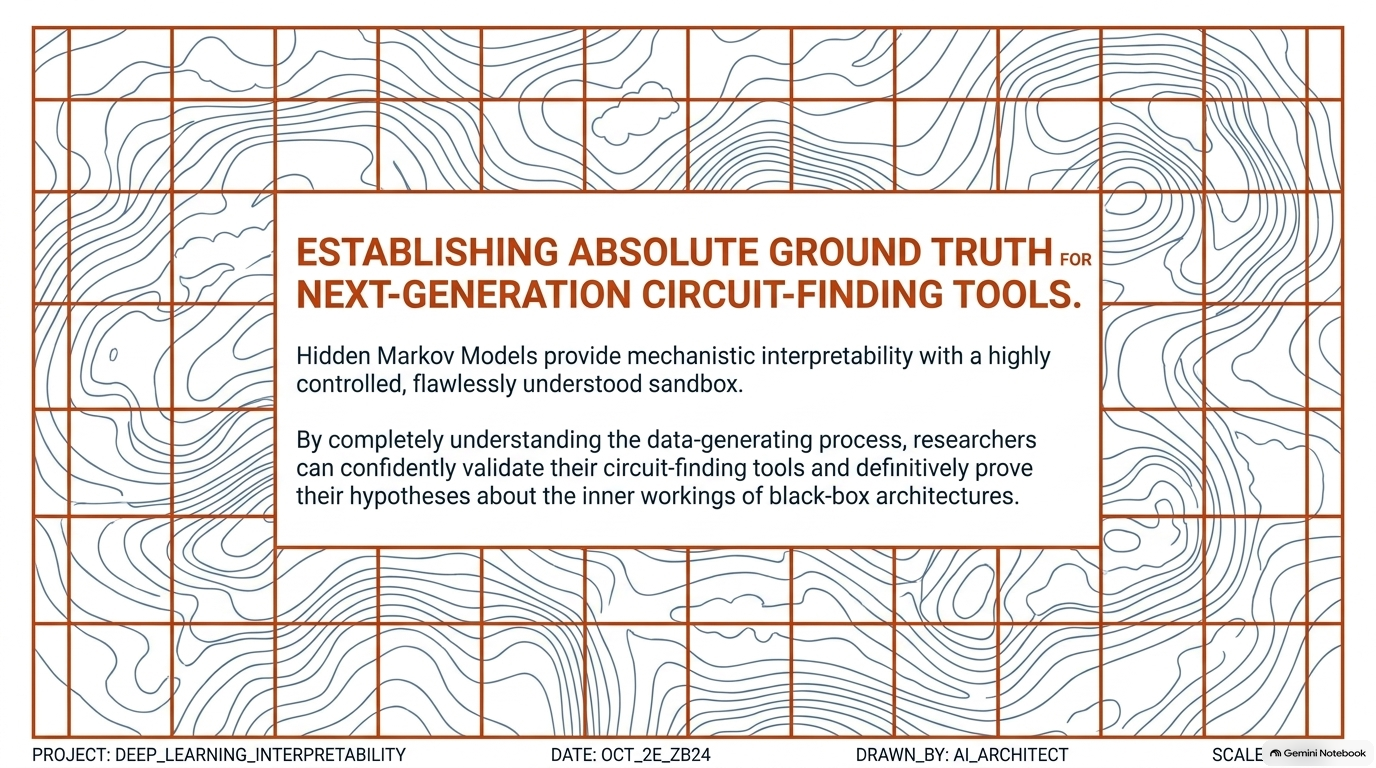
Closing frame: why a fully known sandbox matters for validating the next generation of circuit-finding tools.
Open Source MI Tools
| Category | Tool | Description | Best For | Organization | Source |
|---|---|---|---|---|---|
| Core Interventions & Activation Hooking | TransformerLens | The standard framework in MI research, originally created by Neel Nanda. Re-implements popular transformers (e.g., Llama, Gemma, GPT-2) into a standardized format with explicit, named HookPoints throughout the architecture, plus built-in utilities for activation caching, logit lens readouts, and causal activation patching. |
Analyzing circuit behavior, prompt interventions, and reverse-engineering attention heads on standard transformer architectures. | TransformerLensOrg (community) · originated by Neel Nanda, ex‑Anthropic | GitHub |
| Core Interventions & Activation Hooking | NNsight (and NDIF) | A flexible framework that operates directly on native PyTorch models without requiring manual model re-implementation. Intercepts and modifies tensor streams contextually, and supports remote execution on frontier-scale models hosted on remote clusters. | Large-scale models (70B+ parameters), non-standard architectures, or experiments requiring distributed multi-GPU interventions. | Northeastern University · National Deep Inference Fabric (NDIF) | GitHub |
| Core Interventions & Activation Hooking | pyvene | A declarative intervention library that treats interventions as first-class primitives. Allows configuring complex intervention schemas — e.g., swapping internal representations across multiple forward runs simultaneously — using clean configuration dictionaries. | Causal mediation analysis, distributed alignment search (DAS), and formal causal abstraction experiments. | Stanford NLP Group | GitHub |
| Feature Disentanglement & Sparse Autoencoders (SAEs) | SAELens | The go-to toolkit for training, evaluating, and running Sparse Autoencoders on neural activations. Integrates seamlessly with TransformerLens and Hugging Face models to decompose dense activation vectors into monosemantic, human-interpretable features. | Dictionary learning, feature extraction, and steering model outputs via sparse concepts. | Decode Research (Joseph Bloom, Curt Tigges, et al.) | GitHub |
| Feature Disentanglement & Sparse Autoencoders (SAEs) | Gemma Scope | An open suite of JumpReLU sparse autoencoders trained on every layer and sub-component of the Gemma model family — thousands of pre-trained, open-weight SAEs, saving massive amounts of GPU compute. | — | Google DeepMind | Hugging Face |
| Feature Disentanglement & Sparse Autoencoders (SAEs) | SAE Bench | A comprehensive benchmark of eight diverse SAE evaluations (unsupervised metrics and downstream tasks), open-sourcing a suite of 200+ SAEs across eight architectures and training algorithms. | — | Independent researchers (Adam Karvonen et al.) · interactive interface hosted by Neuronpedia | GitHub |
| Circuit Tracing & Automation | Anthropic Circuit-Tracing Tools | Open-source tools (circuit-tracer) that map internal computation pathways, generating attribution graphs that visually reveal how concepts and features interact layer-by-layer to produce specific outputs. |
Tracing complex multi-step reasoning pathways or understanding safety-relevant behaviors like refusal. | Anthropic (Anthropic Fellows Program) | GitHub |
| Visual Exploration & Notebook UIs | Neuronpedia | An open-source web platform and interactive interface for exploring SAE features and attribution graphs. Search for abstract concepts (e.g., "code syntax," "deception," or specific entities) and inspect feature activations across dataset samples interactively. | — | Decode Research (Johnny Lin, Joseph Bloom) · supported by Anthropic, Open Philanthropy, and others | Site |
| Visual Exploration & Notebook UIs | CircuitsVis | A JavaScript/Python visualization library for inline Jupyter notebook analysis — renders interactive attention head patterns, vector projections, and activation patching heatmaps directly in the research environment. | — | TransformerLensOrg · created by Alan Cooney and Neel Nanda | GitHub |